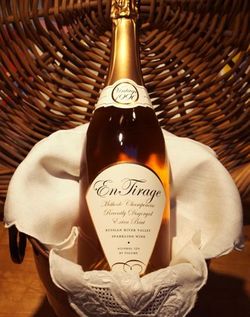
 Now that I have sold the last case of my 1992 En Tirage Extra Brut, I am officially releasing my ultimate vintage, the 1990. This is my effervescent swan song and I have waited 25 years for it to mature to its full potential. Having produced my En Tirage from 1988 through 1992, the 1990 is the last of these sparkling vintages to be released. And while I sold over 500 cases of the 1992, I made the least amount in 1990 and only have 80 cases available for sale.
Each year proved a unique experience. To start with, the 1990 is rose-colored in your glass. The only other year this happened was with the long ago sold-out 1989, whereas in 1988, 1991 and 1992, those sparkling wines were all golden. I have no idea why this happened, because every one of these vintages was made using the exact same methods (methode champenoise). They were all pressed to the same level of pressure, barrel fermented, and encouraged to complete their malolactic fermentations.
Each year they were also bottled with the same level of dosage (added sugar), only 5 grams per liter, which enabled them to earn the Extra Brut designation. Many people say that the higher levels of sugar in most sparkling wines is why bubbly has the reputation for giving people the worst headaches. And since almost all French Champagnes and California sparkling wines have around 15 to 20 grams dosage per liter, this not only makes En Tirage the driest but also kindest bubbly you have probably ever tasted.
Most sparkling wines have only spent between one to three years aging on the yeast (en tirage in the cellar), while the En Tirage has been allowed to slowly mature in the cellar for over twenty years. If you disgorge any sparkling wine after only a year or two, the bubbles will be very large and fill up your mouth with gas instead of good taste. Only extended aging can give you full flavor and those classically elegant, tiny bubbles.
The characteristics of sparkling wines generally reflect either the French or English style. During the many years the British Empire dominated the world stage, they consumed most of what the Champagne region produced. Because of this, some Champagne houses adapted their style to accommodate the English palate, which typically prefers the more toasty, yeasty, creamy qualities exemplified in my 1992 vintage. In contrast, my 1990 En Tirage more clearly reflects the original French style, which showcases delicate varietal fruit flavors instead.